One of the most important things parents can understand before choosing a nursery is the difference between a curriculum or early-years framework and a learning approach or educational philosophy.
EYFS, for example, provides a framework covering children's learning, development and care. Montessori and Reggio Emilia, meanwhile, describe broader educational philosophies that influence how the classroom is organised, how adults interact with children and how learning happens.
That means a nursery can follow the EYFS framework while also being influenced by Reggio Emilia, Montessori, outdoor learning or another educational approach.
Understanding that distinction makes it much easier to compare nurseries based on what children will actually experience every day. If you are beginning your search, you can explore nurseries across Dubai and the UAE or use The Nursery Directory to compare nurseries side by side.
Curriculum vs Learning Approach
Curriculum/framework = what areas of development and learning are supported.
Learning approach/philosophy = how children experience that learning.
Curriculum vs Learning Approach: What Is the Difference?
The words are often used interchangeably, but they describe different things.
A curriculum or framework generally outlines the areas of learning and development that should be supported.
A learning approach or educational philosophy influences how that learning happens.
Think of it this way: The framework helps define what development is being supported. The educational approach influences how the child experiences the learning.
For example, two nurseries may both follow EYFS. One might use a relatively structured daily programme. Another might provide much more open-ended, child-led learning. A third could describe itself as EYFS with Reggio Emilia inspiration. All three could work with the same underlying framework while creating noticeably different classroom experiences.
This is why asking a nursery only "What curriculum do you follow?" does not tell you everything. A better follow-up is: "What would I actually see children doing during a normal morning?"
Parents comparing their options can read our full guide to choosing a nursery curriculum in Dubai.
What Is the EYFS Curriculum?
EYFS stands for the Early Years Foundation Stage. It is the statutory early-years framework used in England and is also widely used by British and international early-years settings in Dubai.
The framework covers seven areas of learning and development.
The Three Prime Areas
- Communication and language
- Physical development
- Personal, social and emotional development
The Four Specific Areas
- Literacy
- Mathematics
- Understanding the world
- Expressive arts and design
EYFS also places significant importance on children's individual development and learning through meaningful experiences and play.
The key point for parents is that EYFS does not prescribe one single classroom style. Two EYFS nurseries can therefore feel very different. A nursery may use child-led play, teacher-guided activities, outdoor learning, projects, sensory experiences, Montessori-inspired resources or Reggio Emilia-inspired environments while still working within an EYFS framework.
Parents specifically interested in this route can compare EYFS nurseries in Dubai or read the British EYFS curriculum parent guide.
What Is the Montessori Approach?
Montessori in Simple Terms
Montessori is an educational approach developed by Italian physician and educator Dr Maria Montessori. One of its best-known principles is encouraging children to become increasingly independent within a carefully prepared environment.
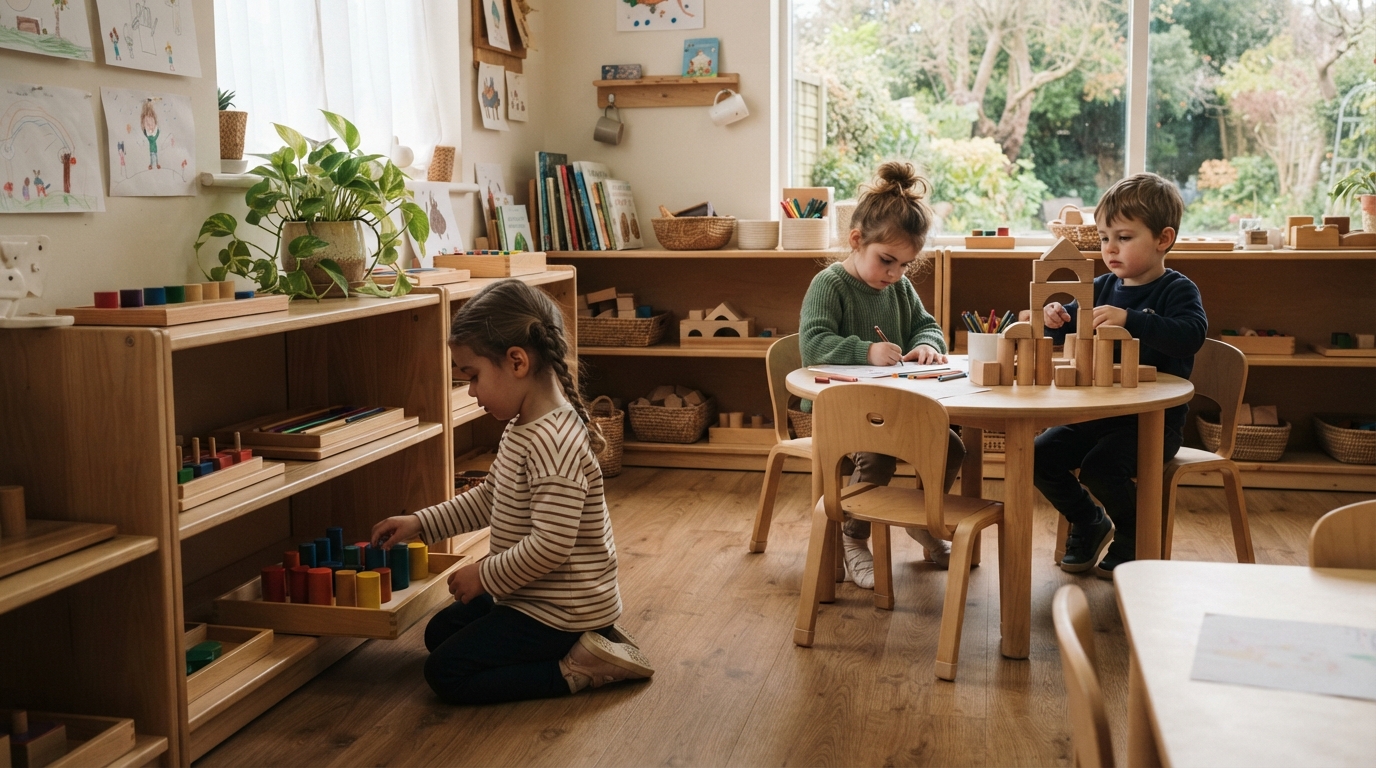
Instead of adults completing every task for children, the environment is designed to allow children to do more for themselves. You might see a child choosing an activity independently, pouring their own water, carrying a tray, fastening clothing, cleaning a small spill, sorting objects, working with specially designed materials, or returning resources to a shelf when finished.
The tasks may look simple, but they can support coordination, concentration, confidence and independence.
What Does a Montessori Classroom Look Like?
Montessori classrooms are often deliberately organised. You may notice low, accessible shelves, carefully arranged materials, child-sized furniture, practical-life activities, relatively uncluttered spaces, resources with a clear purpose, and children working independently or in small groups.
Instead of continuously directing the entire class, the educator frequently observes children, introduces materials and supports individual progression.
What Does Montessori Focus On?
Common Montessori principles include independence, concentration, practical life skills, hands-on learning, order, individual progression, purposeful activity and respect for the child's pace.
Montessori may appeal particularly to families who value independence and want children to become confident completing everyday tasks. However, the word Montessori alone does not guarantee a particular standard of implementation.
During a nursery visit, ask: Are your educators Montessori trained? How much of the day genuinely follows Montessori principles? Are the classroom materials specifically Montessori materials? How does Montessori influence the daily routine?
Parents interested in this philosophy can compare Montessori nurseries in Dubai.
What Is the Reggio Emilia Approach?
Reggio Emilia in Simple Terms
The Reggio Emilia approach developed in the Italian city of Reggio Emilia. It views children as capable participants in their own learning rather than passive recipients of information. Children's questions, ideas and interests can become the starting point for deeper investigation.
Imagine several children become fascinated by shadows in the playground. Rather than treating this as a five-minute conversation and moving on, educators may develop the interest further. Children might draw shadows, photograph them, compare sizes, explore sunlight, create shadow puppets, experiment with torches, discuss why shadows move, or build structures that produce different shapes. One simple observation can therefore develop into language, science, mathematics, creativity and collaboration.
The Hundred Languages of Children
A concept strongly associated with Reggio Emilia is the idea that children have many ways of expressing themselves. Not simply speech. Children can communicate ideas through drawing, construction, sculpture, movement, dramatic play, music, conversation, painting, photography and storytelling. The child's work becomes part of the learning process rather than simply a finished product to take home.
The Environment as a Teacher
The classroom environment is particularly important in Reggio Emilia-inspired settings. You may notice natural materials, open-ended resources, attractive but uncluttered spaces, accessible art materials, documentation of children's thinking, photographs of learning processes, shared project areas and spaces encouraging collaboration. The environment is intentionally organised to invite children to investigate.
Who Might Reggio Emilia Suit?
Families may be drawn to Reggio Emilia-inspired nurseries if they value creativity, project work, collaboration, communication, open-ended exploration, children's ideas and investigation.
To explore the philosophy in more depth, read Reggio Emilia Explained for UAE Parents.
What Is the Forest School Approach?
Forest School is frequently misunderstood as another name for outdoor play. It is more specific than that. Forest School is built around regular and repeated learning experiences in a natural environment over time. It is not simply an occasional trip outdoors or a nursery having a large garden.
Children may participate in activities such as exploring natural materials, investigating insects, gardening, climbing, collecting leaves or stones, building structures, creating with mud or wood, observing seasonal or weather changes, and solving practical outdoor problems. Depending on children's age and the programme, activities may also introduce carefully managed opportunities for children to assess appropriate risks.
What Is Forest School Trying to Develop?
The approach can support areas including independence, confidence, physical development, problem-solving, resilience, creativity and connection with nature.
Forest School vs Outdoor Play
This distinction is worth remembering. A nursery can provide excellent outdoor learning without formally operating a Forest School programme. Similarly, having an attractive garden does not automatically make a nursery a Forest School.
If a nursery uses the term, ask: How often are Forest School sessions held? Who leads them? What training do practitioners have? Is the programme continuous throughout the year? How is risk assessed? How is the UAE climate managed?
Dubai's climate makes this final point particularly important. Outdoor provision may need to change significantly during hotter months, so parents should understand what the nursery actually delivers throughout the year.
What Is Play-Based Learning?
Play-based learning is one of the most common terms parents will encounter when researching nurseries. At first it can sound vague. After all, aren't children supposed to play at nursery?
The key is understanding that in early childhood, play itself can be a powerful learning process. Imagine a child constructing a tower. While playing, the child may be developing hand-eye coordination, spatial understanding, early mathematical thinking, planning, concentration, language, problem-solving and persistence.
If another child joins, the same activity may also involve sharing, negotiation, teamwork and communication. Learning does not always need to look like formal teaching.
Play-based nursery environments may include construction, role play, sensory activities, water play, art, small-world play, music, storytelling, movement and outdoor experiences. The quality of the adult interaction around that play matters significantly.
What Does Child-Led Learning Mean?
Child-led learning means that children's choices and interests have a meaningful influence on their experiences. It does not mean children are simply left to do whatever they want all day.
Educators still observe, plan, guide, ask questions, introduce vocabulary, provide resources and extend children's thinking. The difference is that planning can respond to children's interests.
Imagine children suddenly become fascinated by aeroplanes. Educators could build experiences around that interest through airport role play, maps, books, counting luggage, building aeroplanes, learning about destinations, discussing travel and drawing runways. One interest can support several areas of development simultaneously.
What Is Project-Based Learning?
Project-based learning involves exploring a subject or question in greater depth over time. Instead of completing one isolated activity about sea animals, children might investigate the ocean over several weeks.
They could read related books, create marine artwork, compare sea creatures, investigate floating and sinking, build an underwater environment, learn new vocabulary, ask questions and record observations. Projects can evolve as children's thinking develops.
This style is particularly associated with Reggio Emilia-inspired practice, although nurseries following many different frameworks can use project work effectively.
What Is Nature-Based Learning?
You may also encounter nursery descriptions such as nature-based learning, outdoor classroom, eco-learning, nature kindergarten or outdoor education. These terms do not necessarily mean Forest School.
A nursery can have a strong nature-based philosophy without formally operating a Forest School programme. What matters is what children actually experience.
During your visit, ask: How much of the day do children genuinely spend outdoors? What learning takes place outside besides free play? Do children garden, investigate nature or work with natural materials? How does outdoor learning operate during Dubai's hotter months?
The substance behind the label matters more than the label itself.
Can Nurseries Combine Different Approaches?
Absolutely. In fact, many nurseries in Dubai use blended approaches. You may encounter EYFS with Montessori-inspired learning, EYFS with Reggio Emilia influence, British curriculum with extensive outdoor learning, play-based EYFS, or child-led environments with structured adult-guided sessions.
There is nothing inherently wrong with combining approaches. A blended philosophy can work extremely well. The important question is whether the nursery can explain clearly how the different elements fit together.
Ask: What framework do you follow? Which educational philosophies influence your practice? How are educators trained? How does that philosophy influence a normal day? How do you monitor children's development?
Terms such as Montessori-inspired or Reggio-inspired should represent something parents can actually observe rather than simply appearing in marketing material. For a broader overview, see the most popular nursery curriculums in Dubai.
Nursery Learning Approaches at a Glance
| Approach | Main Focus | Typical Environment | Role of Educator | Often Suits Families Looking For |
|---|---|---|---|---|
| EYFS | Broad learning and development framework covering seven areas. | Varies considerably between nurseries. | Observes, supports, plans and extends children's development. | Families looking for an early-years framework connected with British education. |
| Montessori | Independence, practical skills, concentration and individual progression. | Prepared, orderly classroom with accessible specialist materials. | Observes and introduces appropriate materials rather than continuously directing the group. | Families valuing independence and hands-on learning. |
| Reggio Emilia | Children's ideas, creativity, relationships and long-term investigation. | Open-ended materials, collaborative spaces and strong documentation of learning. | Works alongside children and helps extend investigations. | Families valuing creativity, projects and collaborative exploration. |
| Forest School | Regular learning through natural environments. | Outdoor spaces and natural settings. | Facilitates exploration and appropriate managed risk. | Families prioritising nature, independence and outdoor experiences. |
| Play-Based Learning | Development through meaningful play. | Flexible activity areas including role play, construction, art and sensory learning. | Observes, joins, questions and extends children's play. | Families looking for developmentally appropriate learning through exploration. |
Ready to Compare Nursery Options?
Understanding the approach is only one part of choosing a nursery. Compare curriculum, location, fees, facilities, age groups and other practical details before arranging your visits.
EYFS vs Montessori: Which Is Better?
Parents frequently search for EYFS vs Montessori, but the comparison can be misleading. They are not exactly the same type of system. EYFS is a framework. Montessori is an educational philosophy and method. A nursery can therefore potentially incorporate Montessori principles while also working within EYFS expectations.
The better question is: Which environment suits my child? A child who enjoys long periods of independent concentration may respond very well to Montessori. Another child may thrive in an interactive, play-based EYFS environment. Another may become deeply engaged in collaborative Reggio-inspired projects. There is no universal winner.
Read our full EYFS vs Montessori guide for Dubai families if these are the two options you are considering.
Which Nursery Approach Is Best for My Child?
No educational approach is automatically the best for every child. The nursery itself matters enormously. Excellent educators can create exceptional experiences within different frameworks. Poor implementation cannot be rescued simply by an attractive curriculum label.
Consider your child's personality, age, confidence, communication, independence, attention span, preference for structure, interest in outdoor environments, response to larger groups and favourite ways of playing and exploring.
Then consider your family's practical requirements: location, nursery fees, opening hours, age groups, meals, transport, languages, holiday schedules, future schooling and parent communication.
Curriculum is important. But it is one part of a much bigger decision. The Best Nurseries in Dubai hub can help you explore the wider market, while our How to Choose a Nursery in Dubai guide covers the broader decision-making process.
Questions to Ask a Nursery About Its Learning Approach
A nursery tour is the best opportunity to move beyond marketing language. Instead of asking only what curriculum the nursery follows, ask these questions.
- What curriculum or framework do you follow?
- Which teaching approaches influence your classrooms?
- What would I see during a normal morning?
- How much of the day is child-led?
- How do educators decide what children learn next?
- How do you document children's development?
- What training do educators have?
- How much time do children spend outdoors?
- How much choice do children have during the day?
- How do you prepare children for their next stage of education?
Before visiting, you can compare nursery options side by side to narrow your shortlist.
Frequently Asked Questions About Nursery Learning Approaches
Related Nursery Guides
EYFS Nurseries in Dubai
Read guide →
Montessori Nurseries in Dubai
Read guide →
Choosing a Nursery Curriculum in Dubai
Read guide →
EYFS vs Montessori
Read guide →
Reggio Emilia Explained
Read guide →
British Nurseries in Dubai
Read guide →
The Bottom Line: Look Beyond the Nursery Label
Parents researching nurseries in Dubai will encounter plenty of educational terminology. EYFS. Montessori. Reggio Emilia. Forest School. Play-based. Child-led. Nature-based. Each term can tell you something useful. But none should make the decision for you.
A nursery describing itself as Montessori is not automatically the right Montessori environment. A nursery following EYFS will not necessarily look the same as another EYFS nursery. And a beautiful outdoor space does not necessarily mean a nursery genuinely operates a Forest School approach.
Look beyond the label. Visit the nursery. Watch how educators interact with children. Look at what the children are actually doing. Ask who chooses activities. Understand how the nursery monitors development. Ask how its stated philosophy influences a normal Tuesday morning — not simply what appears in its brochure.
Then consider the educational approach alongside the practical realities of nursery life. Location. Fees. Opening hours. Facilities. Meals. Transport. Age groups. Communication. And most importantly, your child.
The Nursery Directory helps families bring those factors together in one place. You can find nurseries across the UAE, explore the best nurseries in Dubai, browse EYFS nurseries in Dubai, review Montessori nursery options or compare nurseries side by side.
Because understanding the terminology is useful. Understanding what your child's day will actually feel like is what helps you make the decision.
Find the Right Nursery for Your Child
Explore nursery options across Dubai and the UAE and compare the details that matter to your family.