What Does Child-Led Learning Actually Mean? A Parent’s Guide
“Child-led learning” appears everywhere in nursery brochures, websites and tours. But does it mean children decide everything they do? Does the teacher simply watch? And how does it work within EYFS, Montessori or Reggio Emilia? This guide explains what child-led learning really looks like in nurseries across Dubai and Abu Dhabi — without the educational jargon.
What Is Child-Led Learning?
Child-led learning is an approach in which a child's interests, choices, questions and ideas genuinely influence what happens in the nursery that day, that week and sometimes across a whole term. When a child becomes fascinated by diggers, shadows or pouring water, a responsive educator notices that interest and finds ways to extend it — adding vocabulary, introducing new materials, asking thoughtful questions or building a small project around it.
What child-led learning does not mean is that children simply do whatever they want, whenever they want. High-quality early-years education normally combines child-initiated learning, independent play, teacher observation, adult-supported learning, guided learning, intentional teaching, routines and boundaries. Educators still plan, observe, introduce new vocabulary, model skills, ask questions, identify developmental needs and introduce experiences children may not independently choose. They support social and emotional development throughout. A child-led nursery is not an unstructured one — it is one where the child's voice helps shape the route the learning takes.
What Does Child-Led Learning Look Like in a Nursery?
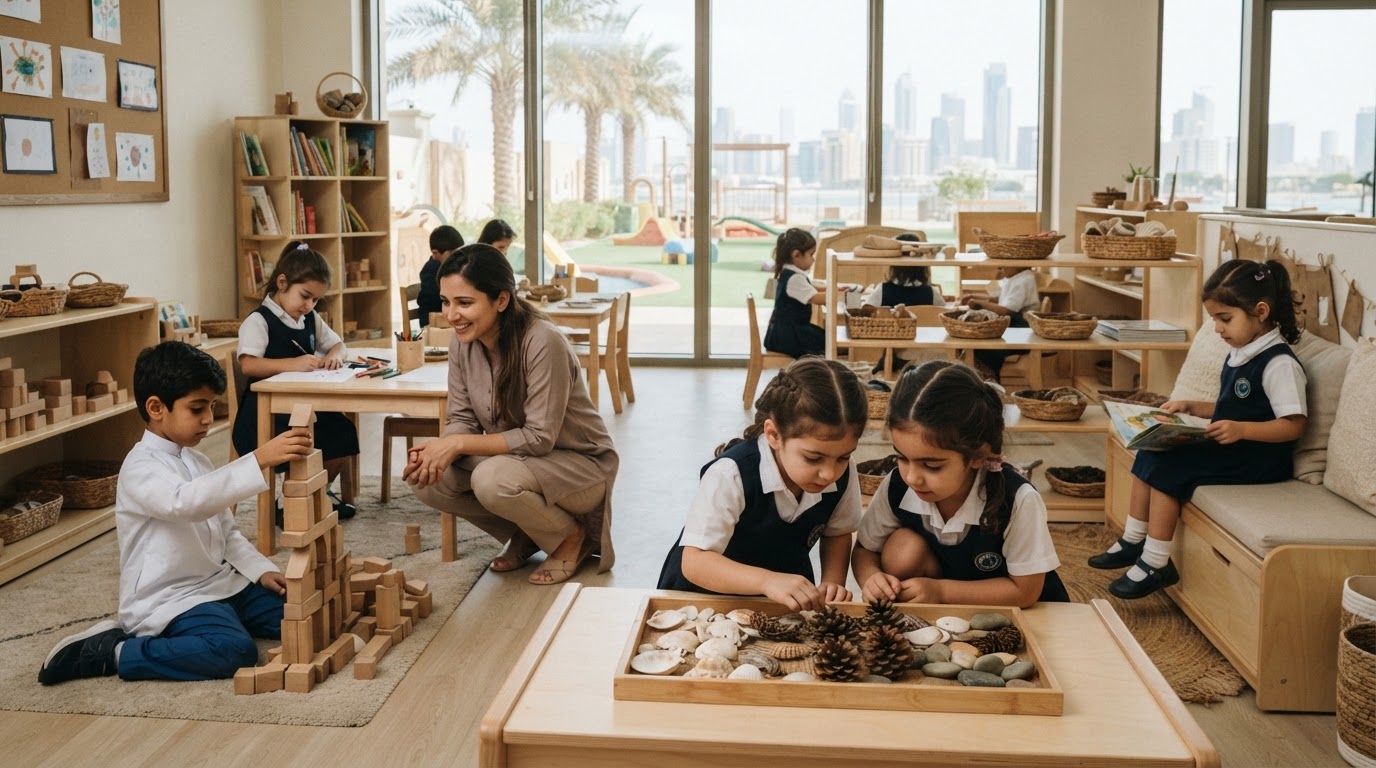
In practice, child-led learning looks like purposeful activity rather than chaos. You might see a child deeply absorbed in building a road from blocks, while nearby two children investigate a tray of shells and pinecones together. An educator sits at the children's level, observing and occasionally joining in — not to take over, but to extend. She might offer the words long, short, beside and underneath as the road grows, or ask, “What could we put underneath it?” when a tower keeps falling.
Consider a child who becomes interested in construction vehicles. An educator might extend that single interest across many areas of learning: toy diggers and blocks for role play and problem-solving, counting wheels for early mathematics, size comparison for language and reasoning, construction-related books for literacy, drawing the vehicles for fine motor development, and new vocabulary such as bucket, track and load. One genuine interest, carefully extended, can support language, mathematics, physical development, problem-solving and social interaction all at once.
Or picture a child who repeatedly pours water between containers. Rather than redirecting them, an educator might introduce the ideas of full and empty, more and less, and encourage prediction: “What do you think will happen if we pour this into the narrower jug?” Through that simple exchange, the child is exploring capacity, coordination, prediction and experimentation — all through an interest they chose themselves.
Child-Led Does Not Mean “Children Do Whatever They Want”
This is the most common misunderstanding. A genuinely child-led nursery still has routines, boundaries, planned curriculum experiences and intentional teaching. Children know when it is time to tidy, eat, rest or go outside. Educators make sure children experience areas of learning they might not naturally choose — a child who avoids the mark-making area still needs gentle, thoughtful encouragement to develop early writing skills.
The difference is that within that structure, children's ideas are taken seriously. If a group of children create a pretend café, an educator might support the play by helping with menus (early literacy), encouraging turn-taking (social development), modelling counting as “orders” come in (mathematics), and extending the role play with real props. The children initiated the idea; the educator helped it become richer learning.
What Is the Teacher’s Role in Child-Led Learning?
Teachers in a child-led setting are anything but passive. Their role is demanding and skilful. They observe closely to understand what each child is interested in and what developmental stage they have reached. They plan experiences that build on those interests. They introduce new vocabulary at the right moment, model skills, ask open questions, and create challenges that stretch children just beyond their current ability. They also identify when a child needs support and when a child needs space to concentrate.
Crucially, they decide when to join children's play and when to step back. Joining too early can interrupt a child's thinking; never joining at all means missed learning opportunities. The skill lies in reading the moment.
Child-Led Learning and the EYFS
The Early Years Foundation Stage (EYFS) originates from England and is widely used or adapted by British-style nurseries internationally, including many nurseries in the UAE. It would be inaccurate to describe the EYFS as completely child-led. Good EYFS practice uses a combination of play, child-initiated experiences, adult interaction, modelling, guided learning and direct teaching when appropriate. The framework sets out what children should gradually learn across seven areas of development, but it gives nurseries flexibility in how that learning is approached — and that is where child-led practice has its place. For a fuller explanation, read our British EYFS curriculum guide.
Child-Led Learning in Montessori
Montessori is often associated with child-led learning, and for good reason. A Montessori environment places a strong emphasis on independence, choice, self-paced activity, accessible resources and a carefully prepared environment. Children are encouraged to select activities independently and to concentrate for extended periods.
However, Montessori is not simply unrestricted free play. The Montessori materials have specific purposes, and educators guide children in how activities are used. A teacher introduces a material, demonstrates its use, and then steps back to let the child explore — but the learning is purposeful and structured within that freedom. To compare settings, you can explore Montessori nurseries in Dubai.
Child-Led Learning in Reggio Emilia
The Reggio Emilia approach is perhaps the most explicitly responsive to children's ideas. It is built around inquiry, long-term projects, children's questions, careful educator observation, documentation, open-ended materials and the belief that the environment itself is an important part of learning.
A practical example: children notice their shadows on a sunny morning in the garden. A Reggio-inspired educator does not simply move on. Over the following days, the interest becomes an investigation — outdoor observation at different times, torches indoors to explore light, drawings of shadow shapes, discussion about why shadows change, even a simple shadow theatre. Children's questions drive the direction, while educators observe, document, question and extend the learning. For a deeper introduction, read our guide to Reggio Emilia for UAE parents.
Child-Led Learning vs Play-Based Learning: Are They the Same?
They overlap, but they are not identical. Play-based learning means that play is the primary vehicle for learning — children learn through play rather than through formal instruction. Child-led learning goes further: it means children's own interests and choices help shape what is explored and how. A nursery can be play-based without being strongly child-led (if adults always direct the play), and a child-led nursery will almost always be play-based too. The two ideas work best together.
A Child-Led Nursery Should Still Have a Curriculum
Some parents worry that child-led means there is no plan. That is not how good nurseries work. A child-led nursery can still have a clear curriculum that establishes what children should gradually experience and learn — communication, physical development, early literacy, mathematics, understanding the world, expressive arts and design, and personal, social and emotional development. What changes is the route. Instead of every child doing the same worksheet on the same day, children reach similar learning goals through different paths shaped by their interests. The curriculum is the destination; child-led practice influences the journey.
What Child-Led Learning Looks Like at Different Ages
Child-led learning looks different depending on a child's age and stage. Understanding roughly what to expect can help parents recognise genuine practice during a nursery tour. For a broader overview of what to expect at each stage, see our guide to child development milestones from ages one to four.
Babies and Younger Toddlers
For babies and younger toddlers, child-led learning is mostly about responsive care. Educators follow the child's cues for feeding, sleeping and play. They talk to babies about what they are looking at, name objects the child reaches for, and provide sensory experiences based on what engages each child. The “curriculum” here is attachment, communication, physical development and security — all delivered responsively.
Around Two Years Old
By around two, children are asserting independence strongly. Child-led practice means offering real choices — which activity, which materials, whether to join a group or play alone — while educators introduce vocabulary, model language and support early social skills. A two-year-old fascinated by pouring and filling is learning about capacity, fine motor control and cause and effect, even though it looks like simple play.
Around Three Years Old
At three, children's interests can sustain over several days. An educator might notice a group interest in building and extend it across the week — adding blocks, books about structures, measuring tools and drawing materials. Children begin to collaborate, negotiate roles and explain their thinking. Educators introduce richer vocabulary and more complex challenges, always building from the child's idea.
Around Four Years Old and Approaching School
As children approach school age, child-led learning often becomes more structured. Educators still follow interests, but they deliberately weave in early literacy and mathematics, sustained concentration, turn-taking and the social skills children will need in reception. The balance shifts gradually towards more guided and adult-led experiences, preparing children for the next stage without losing the engagement that comes from following their interests.
Child-Led Learning in Dubai Nurseries
Dubai families will encounter a wide range of approaches. British and EYFS nurseries, Montessori settings, Reggio-inspired nurseries, bilingual programmes, blended approaches and play-based programmes all exist across the city. Two nurseries may both describe themselves as “child-led” while implementing it very differently — one might mean long uninterrupted play with light adult interaction, while another might mean structured projects that begin from children's questions.
The label alone is not enough. The best way to understand how a nursery actually works is to investigate during a real nursery day rather than relying only on marketing. Ask to see planning, ask for a recent example of a child's interest becoming a learning experience, and observe whether children appear genuinely absorbed. To understand the broader landscape, see our overview of popular nursery curriculums in Dubai, and browse our wider collection of Dubai nursery guides. If you are ready to start comparing specific settings, you can compare top nurseries in Dubai on The Nursery Directory.
Child-Led Learning in Abu Dhabi Nurseries
Abu Dhabi parents encounter a similarly varied picture. British EYFS, Montessori, Reggio-inspired and international blended approaches are all available across the capital. As in Dubai, the curriculum name tells you only part of the story. A genuinely child-led setting in Abu Dhabi should be able to give you a concrete, recent example of children's interests influencing the learning — not a generic statement about “following the child”.
When you tour, ask educators directly: “Can you tell me about a time recently when a child's question changed what you planned?” A confident, specific answer is a good sign. For more context on the capital's options, read our guide to popular nursery curriculums in Abu Dhabi and explore our Abu Dhabi nursery guides.
Why Child-Led Learning Can Be Particularly Relevant in the UAE
Dubai and Abu Dhabi are deeply international communities. Children arrive in nursery from homes speaking different languages, with different cultural experiences, family routines, stories and play traditions. This diversity makes responsive, child-led practice especially valuable. Rather than expecting every child to start from the same place, a responsive educator can start from each child's existing interests, familiar experiences, home language, family routines, stories and play interests — and then broaden learning from there.
A child who has just moved to the UAE might be fascinated by the new environment around them. An educator can build on that genuine curiosity, using it as a bridge into language, social learning and confidence. This responsiveness helps children feel that who they are and what they already know matters, which in turn supports engagement and settling.
What About Children Who Speak English as an Additional Language?
Child-led learning can be especially supportive for children learning English as an additional language, which is common across UAE nurseries. When learning starts from a child's own interest, the child already has motivation and context. The educator can introduce English vocabulary attached to something the child genuinely cares about, which makes the language more meaningful and easier to remember. Play also allows children to communicate and participate before they have full English fluency, reducing frustration and building confidence.
What Are the Potential Benefits of Child-Led Learning?
When it is done well, child-led learning can support a range of important developments. None of these benefits are guaranteed by the label alone — they depend on skilled educators and a thoughtful environment — but the approach is well placed to nurture them.
Engagement
Children are usually more engaged when they are doing something they have chosen. Engagement is the foundation of almost all early learning — a disengaged child learns very little, however excellent the activity is on paper.
Independence
Making real, age-appropriate choices helps children develop decision-making, self-regulation and confidence in their own ideas. Over time, this builds children who see themselves as capable learners.
Communication
When educators extend children's interests with new vocabulary and open questions, language develops in a meaningful context rather than in isolation. Children learn the words for things they actually care about.
Problem-Solving
When a tower keeps falling, or water keeps spilling, or a bridge will not hold the cars, children are solving real problems. An educator who asks “Why do you think that happened?” is teaching reasoning, not just giving answers.
Confidence
Seeing their own ideas taken seriously and developed into real learning experiences helps children develop confidence — not bravado, but a quiet belief that their thinking has value.
Creativity
Open-ended materials and the freedom to combine them in unusual ways nurture creativity. A block can become a phone, a car, a wall or a birthday cake — and that flexibility of thinking is valuable well beyond nursery.
Persistence
When children choose an activity, they are more likely to persist when it becomes difficult. Persistence — the willingness to keep trying — is one of the strongest predictors of later learning success.
Can a Nursery Be Too Child-Led?
Yes. If a setting uses “child-led” as a reason to never introduce new experiences, never teach specific skills, or never guide children towards areas they avoid, then children can miss important learning. A child who never chooses mark-making will not develop early writing without thoughtful adult encouragement. A child who avoids social play needs sensitive support to build the social skills they will rely on at school. The best nurseries balance child-led, adult-supported, guided and adult-led learning — they do not use child-led as an excuse for a lack of teaching.
Child-Led vs Adult-Led Learning
It helps to see child-led and adult-led learning as two ends of a spectrum, with most good nurseries using the full range. The table below shows how the same idea — building a road — might look at different points on that spectrum.
| Approach | Example | Who Shapes It Most? |
|---|---|---|
| Child-led | A child decides to build a road and develops the idea through play | Child |
| Adult-supported | An educator joins the road-building and introduces words such as long, short, beside and underneath | Shared |
| Guided learning | An educator creates a challenge to build a bridge strong enough for several cars | Adult sets challenge, child explores |
| Adult-led | Teacher introduces a new song, story, concept or specific skill | Adult |
Does Child-Led Learning Prepare Children for School?
It can, when it is part of a balanced programme. Child-led experiences help develop communication, independence, concentration, problem-solving, confidence and social skills — all of which matter at school. But strong school preparation also includes guided and adult-led learning, particularly as children get older. Early literacy and mathematics, the ability to follow instructions, take turns and manage transitions, are all supported by a mix of approaches. The balance matters more than the label. A nursery that is only ever child-led may not fully prepare a child for the more structured demands of school; a nursery that is only ever adult-led may not nurture the curiosity and independence that schools increasingly value.
How to Tell Whether “Child-Led” Is Genuine
During a nursery tour, look past the marketing language and observe what is actually happening. The questions below can help you judge whether a setting is genuinely responsive to children, or simply using the phrase. For a fuller set of tour questions, see our 25 questions to ask during a nursery tour.
Are Children Making Meaningful Choices?
Can children genuinely choose activities, materials and sometimes even whether to join a group? Or is every moment directed by adults? Meaningful choice is the heart of child-led practice.
Are Children Deeply Engaged?
Look for concentration, not just busyness. Children flitting from one thing to another without settling is not the same as engaged, purposeful play. Deep engagement is a strong sign of genuine child-led learning.
Are Adults Interacting Thoughtfully?
Are educators at the children's level, observing, asking open questions and extending play — or are they standing back, chatting to each other, or directing everything from the front? Thoughtful interaction is what separates child-led learning from simple free play.
Are Resources Accessible?
Can children reach materials themselves, or must they always ask an adult? Accessible, open-ended resources — blocks, natural materials, art supplies, books — at child height are a practical sign that children are trusted to make choices.
Is There Evidence of Children’s Ideas?
Look at displays. Are they identical, adult-made posters, or do they show children's individual ideas, drawings, photographs of their play and documentation of their investigations? Evidence of children's thinking on the walls is a strong indicator.
Can Educators Explain What Children Are Learning?
Ask a teacher what a child is learning through a particular activity. A skilled educator in a child-led setting can explain the learning behind the play — the mathematics in the water tray, the literacy in the role-play café, the problem-solving in the block area. If the answer is vague, the practice may be less intentional than it appears.
Questions to Ask a Nursery About Child-Led Learning
These ten questions can help you move beyond the label and understand how a nursery actually works day to day.
- What does child-led learning mean in your nursery?
- Can you give me a recent example of a child's interest becoming part of the learning?
- How much uninterrupted play do children usually have?
- How do teachers decide when to join children's play?
- How do you make sure children experience areas they do not naturally choose?
- How do you introduce early literacy and mathematics?
- What parts of the day are adult-led?
- How does the balance change as children get closer to school age?
- How do you track whether children are progressing?
- How do children's interests influence planning?
Should You Choose a Nursery Because It Is Child-Led?
Child-led learning is one factor, not a verdict on whether a nursery is good. A nursery can describe itself as child-led and still be mediocre, just as a more structured nursery can be excellent. The most important questions are whether children are engaged, whether educators are thoughtful, whether the environment is genuinely interactive, and whether the approach fits your child's temperament and your family's values. Some children thrive with lots of choice; others benefit from more structure, particularly when they are anxious or new to a setting. Visit, observe, and trust what you see over what you read in a brochure.
Does Child-Led Learning Cost More?
Child-led learning does not automatically mean a nursery costs more. Fees across the UAE depend far more on location, operating hours, staffing ratios, facilities, meals, transport, programme structure and additional services than on whether the setting describes itself as child-led. A modestly priced nursery can implement excellent child-led practice, and an expensive nursery can be heavily adult-led. When budgeting, it is more useful to compare the full package on each profile. See our guides to nursery fees in Dubai and nursery fees in Abu Dhabi for current fee information.
Can Parents Use Child-Led Learning at Home?
Absolutely, and you probably already do. Following your child's lead at home — noticing what they are interested in, talking about it, offering related materials and asking open questions — is child-led learning in its simplest form. If your child is fascinated by insects, a magnifying glass, a library book and a conversation about where bugs live extends that interest into science, language and care for living things. You do not need to replicate a nursery environment; you simply need to notice, respond and extend. The same principle — start from the child's interest, then broaden — works whether the interest is dinosaurs, drawing, dancing or digging in the sand.
The Best Question Isn’t “Is This Nursery Child-Led?”
A more useful question is: “How does this nursery balance child-led, adult-supported, guided and adult-led learning?” Every good nursery uses all of these. The right mix depends on the children, the age group and the learning goal. A baby room will be mostly responsive care; a pre-school room will have more guided and adult-led experiences. Asking about the balance tells you far more than asking for a yes-or-no answer about child-led learning.
Finding the Right Balance
The strongest early-years settings do not choose between child-led and adult-led. They use both, thoughtfully, depending on what children need and what is being learned. A child who is deeply absorbed in self-chosen play should be given time and space; a child who is avoiding a whole area of learning needs sensitive adult encouragement; a new concept or skill sometimes needs direct teaching. The skill of the educator is in reading which approach each moment requires.
Find a Nursery That Fits How Your Child Learns
Every child responds differently to different environments. The Nursery Directory helps families compare nurseries across Dubai, Abu Dhabi and the wider UAE by location, curriculum, fees, facilities, timings and learning approach. Use the information available on each nursery profile to create a shortlist, then visit the nurseries yourself and observe how their educational philosophy works in practice. You can compare nurseries side by side, or explore nursery options in Dubai to begin building your shortlist.
Frequently Asked Questions
Related Guides

Ready to explore nurseries?
Find the perfect environment for your child's early education. Compare curriculums, locations, and book tours directly.